Black & Veatch ESOP: When You Can Diversify and What Happens When You Leave
This guide is for participants in the Black & Veatch Retirement Program.
A Black & Veatch project manager turns 54 with 14 years at the firm. Her retirement account statement shows two very different kinds of money: 401k funds she picked herself, and a block of BVH, Inc. stock she has never been able to sell. She wants to know when she can start moving some of that stock into something else, and what happens to it if she takes an offer from another firm next year.
The plan by the numbers
Black & Veatch moved to employee ownership in 1999 and became 100 percent ESOP-owned in 2015. An ESOP, or employee stock ownership plan, is a retirement plan that holds the employer's own stock for employees. Unlike Burns & McDonnell, which keeps its ESOP and 401k in two separate plans, Black & Veatch runs both inside one plan, the Black & Veatch Retirement Program. That one plan holds your 401k savings, the company match, and the ESOP stock.
Here is what the plan reported for the 2023 plan year, the latest audited filing available under its sponsor number.
| 2023 plan year | Amount |
|---|---|
| Net assets in the plan | $2.73 billion |
| BVH, Inc. stock held by the plan | $1.16 billion, about 42% of assets |
| Participants with account balances | 10,328 |
| Average balance per participant | about $264,600 |
| Company ESOP contribution | $85.0 million |
| Company matching contribution | $26.0 million |
| Participant contributions | $86.2 million |
Source: Black & Veatch Retirement Program Form 5500 and audited financial statements for 2023. Averages are plan-wide and include long-tenured employees. They are not a target for any individual.
About 42 percent of the plan sits in one private company's stock. For an individual employee-owner the share can be far higher or lower depending on tenure and how much they have saved on their own in the 401k side.
How the ESOP contribution works
For 2023 the company made an ESOP contribution equal to 10 percent of each participant's eligible salary, up to the IRS pay limit of $330,000, paid in a mix of stock and cash. That is separate from the 401k match, which in 2023 was 50 cents per dollar on the first 6 percent of pay you contribute. Catch-up contributions are not matched. The ESOP contribution is a company decision each year, so the 10 percent figure describes 2023, not a promise for future years.
New employees are enrolled automatically at 6 percent of pay, and the rate rises 1 percentage point on each enrollment anniversary up to 15 percent unless you change it.
There is no market price for the stock. An independent appraiser values it once a year, as of December 31, using a mix of market comparisons and income-based methods. Between the 2022 and 2023 appraisals, the plan's stock holding rose from $1.036 billion to $1.156 billion with the same number of shares, an increase of about 11.5 percent in the appraised value per share.
Vesting: what is yours if you leave
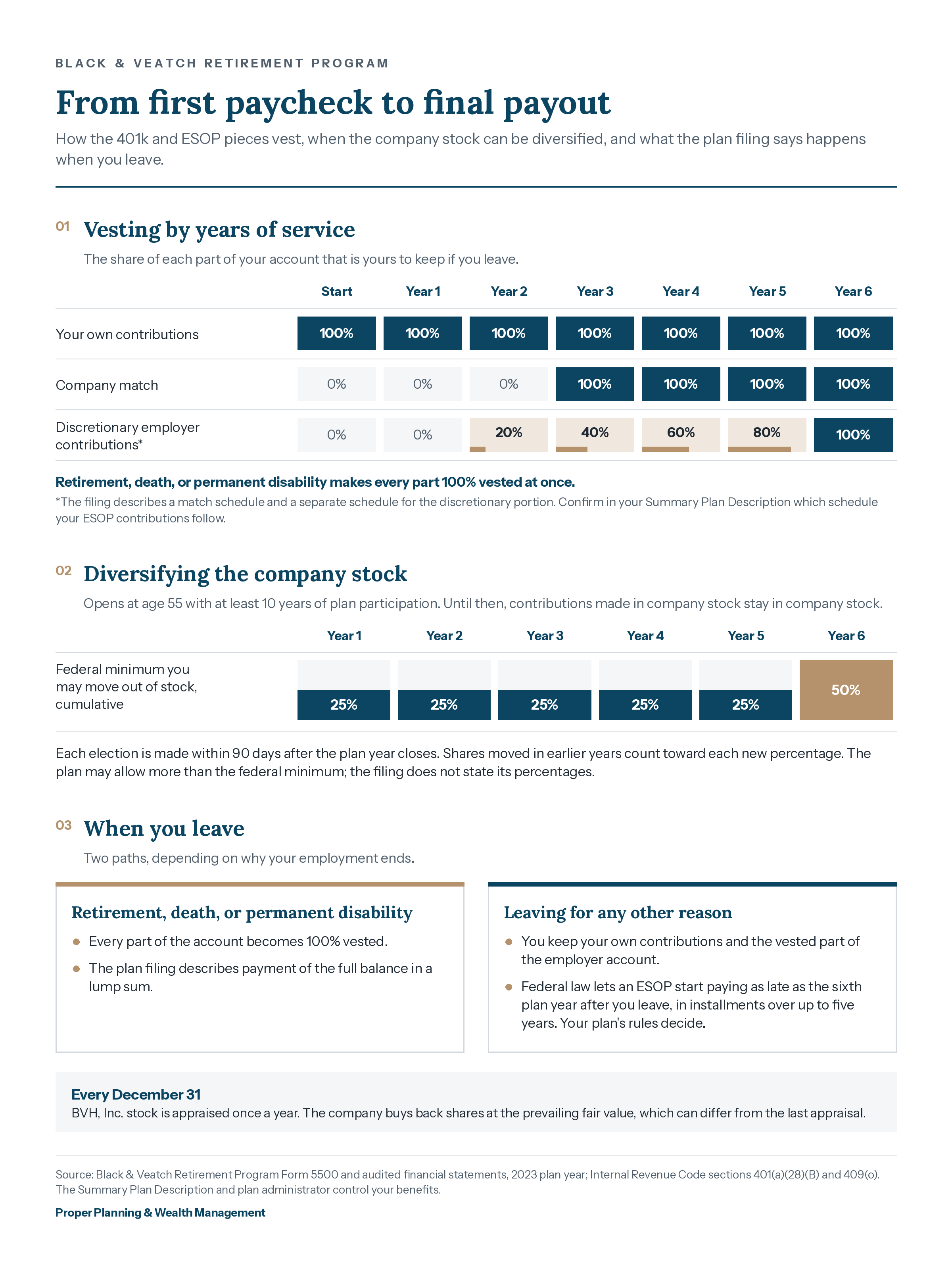
Vesting is the schedule that decides how much of the company's money you keep if you leave. Your own contributions are always 100 percent yours. The company match is fully vested after three years of credited service, and nothing is vested before that. The filing describes a separate schedule for the discretionary employer portion of the account: 20 percent after two years, rising to 100 percent after six. The filing does not say in so many words which schedule applies to the ESOP contribution, so confirm that in your Summary Plan Description.
Retirement, death, or permanent disability makes everything 100 percent vested at once. In 2023, 499 participants left the plan before they were fully vested. If you are weighing a move in your second through sixth year, check your service date first. Leaving a few weeks before an anniversary can cost a full 20 percent step of the employer account.
When you can diversify the company stock
Stock the company contributes has to stay in company stock until you retire, leave, or become eligible to diversify. You become eligible at age 55 with at least 10 years of participation in the plan.
The filing does not list the percentages or the election window, so federal law sets the floor. Under Internal Revenue Code section 401(a)(28)(B), you get six annual elections. In each of the first five you may move at least 25 percent of your company stock into other investments, and in the sixth at least 50 percent. The percentages are cumulative, so shares you already moved are counted before the new limit is applied. Each election must be offered within 90 days after the plan year closes, and for a private company the window often opens once the new appraisal is communicated rather than on January 1. A plan can be more generous than this floor; your Summary Plan Description says whether it is.
At Black & Veatch, the diversified money stays inside the plan and moves into its other investment options, so there is no tax and no penalty when you diversify.
The 401k side of the account is where most employee-owners can diversify right now. Your own contributions and the match can go into the plan's other investment options, and the plan also offers a self-directed brokerage window. If the ESOP gives you a large position in one engineering and construction company, the 401k side may not need much more exposure to industrial stocks. We looked at how hidden concentration builds up in ordinary index funds in Are You Actually Diversified?
What happens when you leave
The filing separates two cases. If you leave because of retirement, death, or permanent disability, you are fully vested and the filing describes payment of your full account in a lump sum. If you leave for any other reason, you keep your own contributions and the vested part of the employer account, but the filing does not state when the stock portion is paid.
Federal law gives ESOPs room on that timing. Under section 409(o), a plan may wait until the sixth plan year after the year you leave before starting payments for a departure other than retirement, disability, or death, and it may pay in installments over up to five years. For 2026, balances above $1,455,000 can be stretched one additional year for each $290,000 above that amount, up to five more years. Whether Black & Veatch uses any of that room is a plan rule, so if you are considering another job, ask HR for the distribution section of the Summary Plan Description and put the payout schedule in the comparison alongside salary.
When shares are distributed or diversified, the company buys them back at the prevailing fair value, which the filing notes can be higher or lower than the last December 31 appraisal. The plan reported paying no 2023 distributions in property other than cash. Black & Veatch is an S corporation, and federal law lets S corporation ESOPs pay benefits in cash. That matters for one tax strategy: net unrealized appreciation, a rule that can tax the growth on employer stock at capital gains rates, generally requires receiving actual shares. If the plan pays cash, plan on that strategy being unavailable.
A lump sum that is not rolled into an IRA or another plan is taxable as ordinary income in one year and, before 59½, can carry a 10 percent penalty unless an exception applies. A six-figure distribution landing in a single year can also raise Medicare premiums two years later, which we covered in Retired, but Medicare Still Uses Your Old Salary?. A direct rollover avoids both and keeps the money working while you decide how to draw it down.
Decisions worth getting right
Count the stock twice. Your paycheck and a large part of your retirement account both depend on the same company. That has rewarded Black & Veatch employee-owners well, and it still argues for treating the ESOP as your stock allocation and building the 401k side around it.
Mark the dates that move money: your vesting anniversaries, your 55th birthday and 10-year participation date, each December 31 appraisal, and the diversification election window that follows it.
Before you retire, decide where the lump sum goes. The rollover paperwork is simple. Choosing the year it arrives and what it funds first takes more thought, because it sets your tax bill for that year and the next two.
Our Burns & McDonnell guide covers the same questions for the other large employee-owned engineering firm in town, and the differences between the two plans are a good reminder that the plan document, not general ESOP advice, is what decides your answers.