
Retired, but Medicare Still Uses Your Old Salary? How to Request an IRMAA Review
A couple retires at the end of 2025. Their income falls, but their 2026 Medicare premiums still reflect the salaries they earned in 2024. Their retirement budget includes an extra charge for being high earners, even though their working years are behind them.
This can happen because Medicare generally looks back two years when determining income-related surcharges. Retirement may give them a way to ask Social Security to use more recent income information. For a household paying these charges, that review is part of a comprehensive financial plan.
Why an old tax return can affect today's Medicare bill
The extra charge is called the income-related monthly adjustment amount, or IRMAA. It can apply to Medicare Part B, which covers physician and outpatient services, and Part D prescription drug coverage.
For 2026, Social Security generally uses income from your 2024 federal tax return. It looks back 2 years. If that information is unavailable, it may use 2023. The notice you receive identifies the tax year and income used in the calculation. Social Security explains the income lookback here.
The calculation uses modified adjusted gross income, or MAGI. For Medicare purposes, that means your adjusted gross income from your federal tax return plus tax-exempt interest. Municipal bond interest can therefore count even when it is exempt from federal income tax. Your spending budget and your MAGI are different numbers. See Social Security's MAGI definition.
In 2026, surcharges begin above $109,000 for an individual filer and above $218,000 for a married couple filing jointly. Separate rules apply to married people filing separately who lived together during the tax year. The standard Part B premium is $202.90 per month; IRMAA adds to that amount. Part D IRMAA is an additional charge on top of the drug plan's own premium. Source: CMS 2026 premium tables.
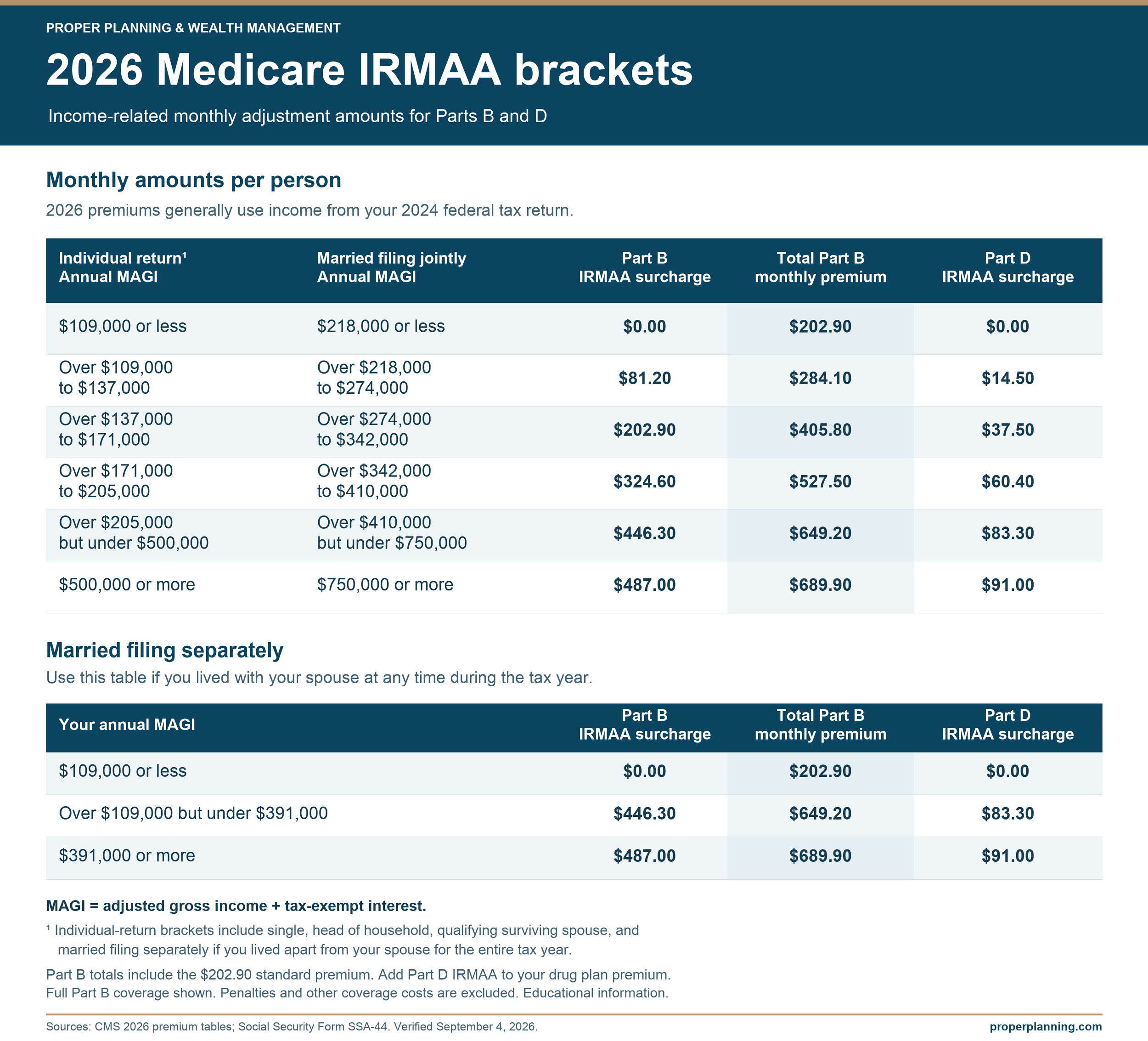
What a review could mean for a retired couple
Consider a hypothetical couple who file jointly and are both enrolled in full Part B and Part D coverage throughout 2026. Their 2024 MAGI was $300,000. After retiring at the end of 2025, they expect their 2026 MAGI to be $170,000.
Here is how those income amounts compare under the 2026 surcharge schedule:
Income-related chargeUsing $300,000 MAGIUsing $170,000 MAGIPart B surcharge, per person each month$202.90$0Part D surcharge, per person each month$37.50$0Combined surcharge, both spouses each month$480.80$0Combined surcharge, both spouses over 12 months$5,769.60$0
These figures exclude standard Medicare and drug plan premiums. They show a rate comparison, not an approved reduction or promised refund. Social Security must accept the request and determine which months are affected. Rates: CMS.
Use the comparison tool below to see how two income amounts fall within the 2026 schedule. It can help you understand the dollars involved before gathering your paperwork.
Retirement can qualify, including a spouse's retirement
Compare your 2026 Medicare surcharges
See how two annual income amounts affect the extra charge for Medicare. MAGI means adjusted gross income plus tax-exempt interest. For a joint return, enter the couple's combined MAGI.
For single filers or married couples filing jointly with the same filing status in both years. If your status changed or you use another filing status, ask Social Security to compare the applicable rules.
Example: married filing jointly, comparing $300,000 with $170,000 of annual MAGI.
| Charge | Notice income | New income |
|---|---|---|
| Part B | $202.90 | $0.00 |
| Part D | $37.50 | $0.00 |
| Total | $240.40 | $0.00 |
$2,884.80 lower per person over 12 months.
For two spouses with this same coverage all year, the annualized difference is $5,769.60.
Both scenarios use 2026 rates. This comparison does not establish eligibility, predict a refund, or forecast future premiums. Annualized figures assume 12 months of the selected coverage. Social Security decides whether newer income can be used and which months apply. Standard Part B premiums ($202.90 monthly), drug plan premiums, penalties, and other coverage costs are excluded.
This tool processes entries in your browser and does not save or send them. No personal identifying information is needed.
Sources: CMS 2026 rates and Social Security's review instructions.
Social Security recognizes stopping work and reducing work hours as qualifying life-changing events when they cause an income reduction large enough to lower or eliminate IRMAA. The change can involve you, your spouse, or both of you. A business owner who stops working after selling a business may also qualify, depending on the income and circumstances. Source: Social Security's work-stoppage policy.
Other recognized events include marriage, divorce, and the death of a spouse. Certain losses of pension income or income-producing property can also qualify under specific conditions.
A one-time income spike by itself generally does not qualify. Social Security lists capital gains from selling property and an IRA conversion as examples of events that do not independently justify this type of review. If a qualifying retirement also occurred, the request needs to explain that event and the resulting income reduction. See the qualifying and nonqualifying events.
How to request a review with Form SSA-44
Start with your IRMAA notice, your tax information, and documentation of the work change. Then work through these steps:
Check the notice. Confirm the income amount, filing status, and tax year Social Security used. If it used 2023 information for your 2026 premium even though your 2024 return is available, contact Social Security about updating its records.
Prepare the more recent income estimate. Follow the SSA-44 instructions to identify the appropriate year. For a 2026 review, that may be 2025 or 2026, depending on when income fell and whether it will fall further. You may use an estimate if the applicable return has not been filed.
Document the event. A retirement letter, employer statement, or business-transfer record may help establish when work stopped. Follow Social Security's instructions for acceptable evidence.
Submit the request. Social Security offers an online route to complete and submit Form SSA-44, titled Medicare Income-Related Monthly Adjustment Amount: Life-Changing Event. You can also submit the form and evidence by mail or fax, or arrange an appointment.
Address both spouses and follow up. Each affected spouse must contact Social Security. One spouse's report does not automatically update the other's determination. Keep the submission and decision, provide the filed return when requested, and update Social Security if your income estimate changes.
The official SSA request page provides submission options. The SSA-44 form and instructions explain the tax-year selection and evidence requirements. The separate-spouse requirement appears in Social Security's work-stoppage policy.
People often call this an “IRMAA appeal.” For a qualifying life event, Social Security describes the process as asking for a new decision using updated information. A formal appeal is also available if you disagree with a determination. Follow the instructions and deadlines in your notice for the route that applies. Social Security explains both routes.
Build the estimate around your whole retirement year
Stopping a paycheck changes one part of your income. Your projection also needs to account for taxable retirement distributions, investment income, realized gains, and any taxable amount converted to a Roth IRA. Tax-exempt interest must be included in Medicare MAGI as well.
A late-year retirement can leave substantial wages on that year's return. A business sale can produce taxable income in the same year the owner stops working. Those details help determine which more recent year's income should support the request.
This is where the review connects to your broader plan. Before making a large withdrawal or conversion, update the tax projection and consider the Medicare effect alongside your cash needs and longer-term goals. A transaction can still make sense after accounting for an additional premium. The full cost belongs in the decision.
The tool uses 2026 premium rates for both scenarios. It does not forecast future Medicare costs. Under the usual two-year lookback, 2026 income would generally affect 2028 premiums, using the rates and thresholds applicable to that future year.
Put the notice next to your retirement plan
If your Medicare surcharge reflects income from before retirement, gather the notice, document when work changed, and prepare a realistic estimate of your annual income. Those three items give you a useful starting point for a conversation with Social Security and your planning team.
At Proper Planning & Wealth Management, we help connect retirement income decisions with investment planning and tax coordination. If you would like help understanding how your Medicare costs fit into that picture, schedule a complimentary meeting.
This article is for educational purposes. Examples are hypothetical, and individual circumstances differ. Social Security determines IRMAA adjustments. Neither Proper Planning & Wealth Management nor LPL Financial provides tax or legal advice; consult your tax or legal advisor about your situation. Rates shown are for 2026.